I. Is the Old King Dead?
There's a narrative making the rounds online — "the old king is dead, long live the new king."
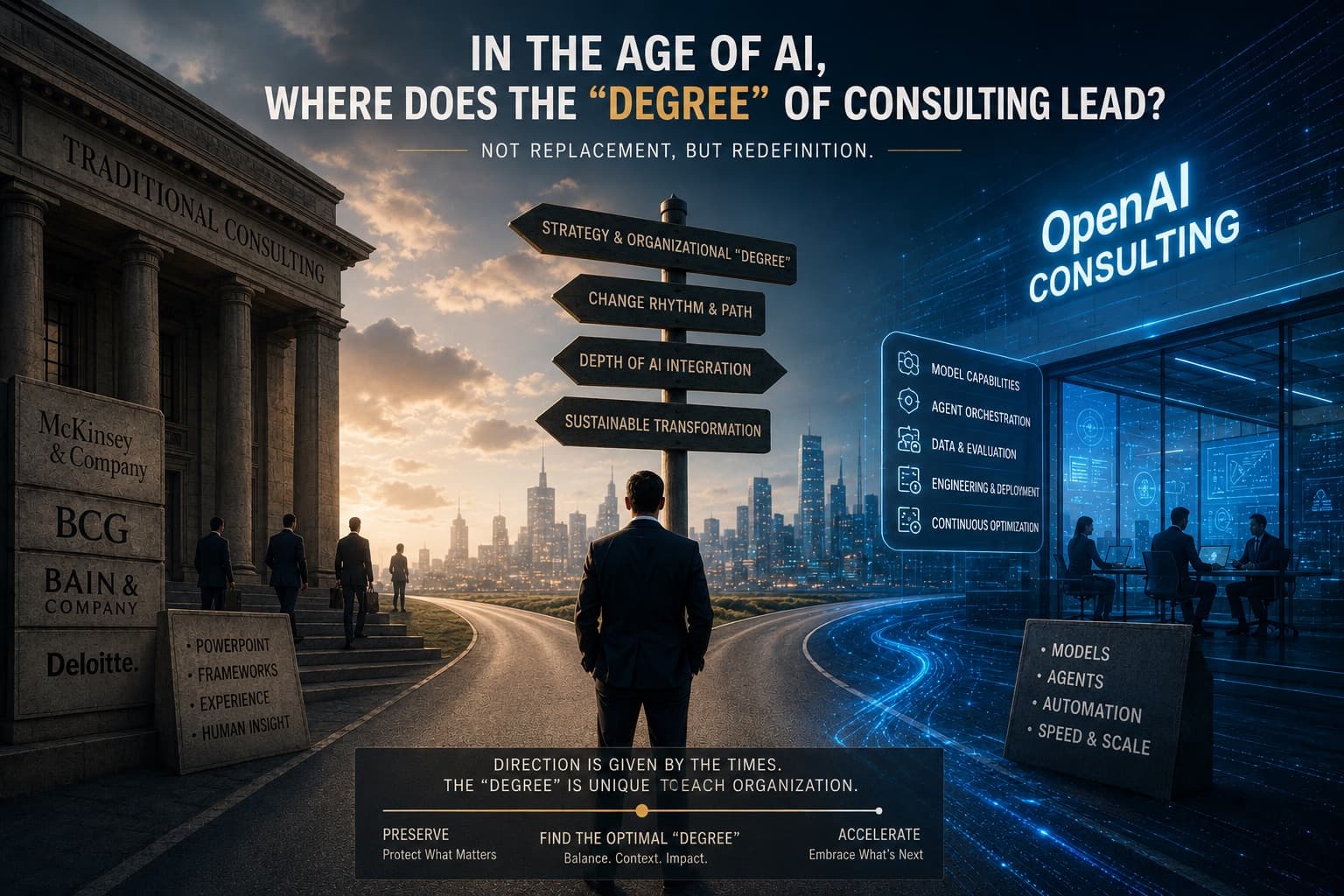
The reasoning goes like this: OpenAI has stood up its own consulting arm, offering AI implementation services directly to enterprises. And so a chorus of voices has rushed to declare that the era of traditional consulting is over — that McKinsey, BCG, Bain, and the Big 4 are about to be steamrolled, one by one, by "native" teams armed with GPT.
It sounds dramatic. But is it actually true?
OpenAI moving into AI consulting makes perfect sense on its own terms. They have the most native view of their own platform — they know the model's capability ceiling, the token economics, the API roadmap, the product cadence. Packaging that know-how into "AI application implementation" is essentially a deeper monetization of their own platform — a technology supplier extending one step downstream. Almost every platform company eventually walks this path.
But what actually struck me about the news isn't whether OpenAI should be doing consulting. It's the larger question it surfaces:
In the AI era, where do the traditional top-tier consulting firms go? Will their moat get undermined from the bottom up by AI-native players, or will it be reshaped into something new?
Before we can answer that, we have to acknowledge one thing —
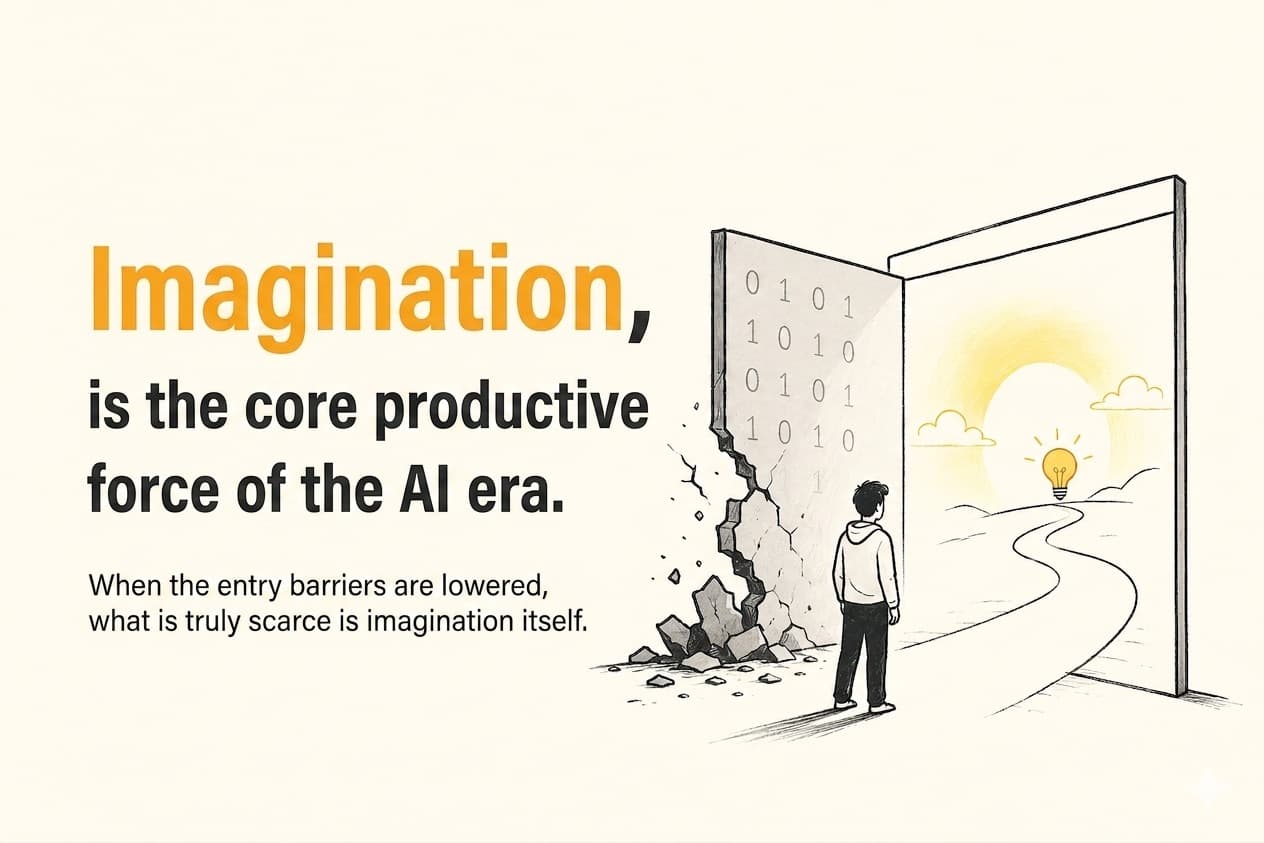
We are standing at the doorway of an era.
II. The Doorway
Every genuine transformation in human history began the same way: not with everyone stepping into the new world at once, but with a small group pushing the door open while the rest hesitated outside.
That's exactly where we are today.
The AI era is no longer a future-tense "will arrive" — it's a present-tense "is happening." Some people, some companies, have already walked through the door. Many more are standing outside, watching, testing, debating. As more participants cross the threshold, the creativity and productivity unleashed by AI will scale non-linearly.
But transformation has never been a gentle process.
The more people gather at the doorway, the more intense the argument becomes. Inside every company facing AI right now, an invisible debate is unfolding — and the shape of that debate is far more complex than "should we use AI or not."
III. Four Postures Inside the Company
In the companies I've observed, the response to AI has visibly splintered into four factions. These aren't just differences in technology choice — they're divisions of organizational belief.
1. The Status Quo Believers.
They are convinced that "what worked for the last twenty years will keep working." AI, in their eyes, is either an overhyped bubble or a demo-stage toy. Processes, headcount, and org structure stay untouched. "Our industry is different" is their most-used sentence. They aren't necessarily opposed to change — they're often just waiting for "enough evidence." But AI's iteration speed isn't going to wait for them.
2. The Light Adopters.
They acknowledge that AI has value, but the value stops at "knowledge assistant." Microsoft Copilot chatbots, the ChatGPT text box, email draft generation — in their hands, AI is essentially a search engine that can also write. The workflow hasn't moved. The org hasn't moved. They've just swapped Google for GPT. This is the largest camp, and the easiest to fall into self-soothing: "we're already using AI."
3. The Workflow Re-architects.
They start embedding AI into the critical joints of the workflow itself: automated document generation, MCP-style integration into internal systems, audio transcription, contract drafts, code review, ticket triage. One link at a time gets replaced or restructured. Inside the org, tension begins to surface between the "AI-native teams" and the "traditional teams." These are the people who first experience the real productivity gain — and the first to slam into the ceiling of organizational process.
4. The Full Embracers.
They redefine the role of humans — from executors to editors, reviewers, taste-makers. The coder is no longer the person writing code, but the person reviewing what AI produced. The analyst no longer writes the report — they interrogate the report the AI generated. AI stops being a tool and becomes the default collaboration partner. The organization gets redesigned from the bottom up. This faction tends to live in startups, or in newly-formed AI-native units inside larger companies. Inside a big enterprise, they often feel less like a colleague and more like a missionary.
IV. The Inevitable Conflict
These four factions don't coexist peacefully.
Budget fights, voice-of-authority fights, KPI fights, who-takes-the-blame fights — the same script every era of transformation has played out. The Status Quo camp thinks the radicals are wrecking the company. The radicals think the Status Quo is letting the company die. The Light Adopters get dismissed by both sides as not committed enough. And the Full Embracers, more often than not, discover that they look more like preachers than peers inside their own org.
Every large company going through AI transformation right now is fighting this invisible civil war.
And this war won't be settled by technology — because it was never a technology problem in the first place.
It's a problem of "degree."
V. The Echo of History
To understand why "degree" is the real question, it helps to step back three hundred years.
The 17th through 19th centuries were one of the great global transformations of human political systems — a tug-of-war between royal authority and rising classes, between tradition and modernity, between absolutism and representation. Different countries walked completely different paths.
Britain went the gradualist constitutional route. The Glorious Revolution didn't behead the king — it placed the king inside the cage of Parliament. A compromise. A new system that kept the old symbols intact and remained sustainable. Preserve the old form, replace the old core — that was Britain's wisdom.
France went the radical revolutionary route. From 1789 to Napoleon, then to restoration and re-revolution, the guillotine and the imperial throne traded places repeatedly over seventy years. Total transformation — at enormous cost. The speed of revolution cannot exceed the speed at which society can absorb it. That was France's lesson.
Germany and Japan went the semi-constitutional route. The Meiji Restoration and German unification were both hybrid paths: keep the emperor as a symbol, graft a modern state apparatus onto him. Use old symbols to carry new systems — the favorite lever of late-arriving nations.
Late-Qing China went through a series of failed attempts. The Self-Strengthening Movement, the Hundred Days' Reform, the constitutional preparation, the Xinhai Revolution — each one hesitated between "how much to move" and "how much to keep." Each one alienated the old guard while failing to win over the new, and ended up being run over by history. Every compromise comes with a cost — but the cost of indecisive compromise is the highest of all.
Read this history once, and the lesson sounds familiar:
Those who flow with the tide prosper. Those who fight it perish.
Read it a second time, and a more hidden — but equally important — lesson emerges:
No country has ever succeeded by copying someone else.
Britain's constitutional path wouldn't have worked in revolutionary-era France. France's revolution wouldn't have worked in Britain. Constitutional monarchy suited Meiji Japan but couldn't save late-Qing China. Every successful transformation was tailored — based on national context, industrial structure, social maturity — to a unique calibration of degree.
The direction of change is an objective law. The degree of change is a subjective engineering problem.
VI. The AI Era Is Structurally Identical
Translate this historical lesson onto today's enterprise AI transformation, and the logic is almost identical.
Embracing AI is the inevitable direction — no debate. Just as, after the 19th century, no nation could refuse industrialization and the modern state and expect to survive.
But how to embrace it, to what extent, in which workflows, while preserving which "old institutions" as a buffer — that's a deeply company-specific question.
The optimal AI integration for a hundred-year-old manufacturing company cannot equal that of a SaaS-native startup. A financial institution under heavy compliance constraints cannot push AI to its customer-facing front line the way a creative agency does. An organization built around engineering culture has a completely different tolerance for "AI fully taking over" than one built around domain experts.
AI is not a binary choice between constitutional monarchy and republic. It's a continuous spectrum.
The optimal answer for any given company is rarely at either extreme — it lives at some precisely calibrated point in the middle.
VII. So Where Do the Top-Tier Consultancies Go?
Now we can return to the question we opened with.
OpenAI launching consulting — is this really "the old king is dead"?
My answer is — not replacement. Division of labor.
OpenAI's consulting is, by nature, vertical consulting: its strongest ground is "how to ship AI into a specific application." Which model, how to write the prompts, how to orchestrate the agents, how to manage cost, how to compress latency, how to build evaluations — that's the irreplaceable advantage of a platform-native team. If a company's problem is "I want to build an AI customer service bot / an AI legal assistant / an AI report generator," a player like OpenAI is almost certainly the better choice.
But the real moat of top-tier consulting was never technical implementation.
It is horizontal consulting — the ability to look at problems across industries, across organizations, across decades.
The question it needs to answer is not "how do you deploy AI?" — it's "in your company's specific context, where should the degree of AI integration actually stop?"
These are two completely different things.
Concretely, three jobs are the most irreplaceable work of top-tier consulting in the AI era.
First — diagnosis.
Identifying the real weight of each of those four factions inside a company, the cultural friction, the technical debt, the organizational maturity. Turning an invisible civil war into a map that can be talked about. OpenAI won't do this — because OpenAI doesn't live inside the political structure of that company.
Second — calibration.
Drawing, for this specific company, its own optimal integration curve between the radical and the conservative. A single company can only see its own sample. A consultant has seen dozens, sometimes hundreds, of AI integration trajectories — they know which roads lead somewhere and which roads dead-end. That's a capability the platform view will never have. OpenAI sees "companies that use AI." Consulting sees "this company, in this industry."
Third — accountability.
A transformation decision is never just about "being right" — it's about "having someone who can be held responsible for it." In a transformation that will inevitably trigger internal conflict, a third-party decision framework with professional backing and accountable signature is itself the institutional buffer the organization needs. No technology vendor can provide this — you don't ask your vendor to take the blame for your internal civil war.
And precisely because AI's capability ceiling keeps getting redrawn, the "right degree" keeps moving — meaning consulting's value isn't a one-shot deliverable. It's a continuous strategic recalibration.
OpenAI's consulting will make "how to deploy AI" cheaper and more standardized. But at the same time, "how much to deploy, where, and when" will become more complex — and more valuable.
In an era where everyone is anxious about falling behind, the people who can tell a company "how fast you should move, and how far you should go" will be needed more than ever.
VIII. Closing
Beneath the current of history, no one can reject AI — just as three centuries ago, no one could reject industrialization and constitutional modernization.
But those who cross the current safely have never been the ones running fastest. They've been the ones seeing most clearly.
Back to the "old king is dead" line — it got half of it right, and half of it wrong.
The old consulting model — the "PPT + framework + generic methodology" playbook — is indeed being phased out, faster than ever, by the AI era. But consulting as a thing — as a professional service that spans industries, spans organizations, and calibrates the degree of transformation for the enterprises that need it — its demand is not going to disappear. It is going to be amplified, more than at any point before.
The direction of AI adoption is already written on the wall.
The degree of AI adoption still has to be calculated, one company at a time.
And that calculation — that is the seat the AI era leaves open for top-tier consulting.