I. The High Schooler at the Doorway
Lately I keep scrolling past these posts on X and Xiaohongshu — a high schooler, an English major, someone who's never taken a CS class in their life, vibe-coding their way to a product that makes me look twice.
As a CS-background engineer, I'll be honest: those posts shake something loose in me.
It's not jealousy. It's closer to the feeling of the ground shifting underfoot — a threshold that used to require few years of undergrad and a few more of engineering experience seems to have quietly collapsed by half overnight.
Collapsed, then what? Where does that leave me as a programmer?
II. After the Threshold Collapses
To answer that question honestly, I have to first concede a fact: the bar for writing code is genuinely being flattened by AI.
But that doesn't mean everything that was valuable about being a programmer is being flattened with it.
Once I thought it through, this is the conclusion I landed on:
A lower threshold doesn't mean a lower ceiling.
Quite the opposite — when the floor sinks, the ceiling actually gets pushed higher.
A sinking floor is the universal upside: more people get to ship things, more strange and lovely products get built, more ideas that used to die in resource jails finally get to run. That part excites me.
But the ceiling being pushed up is a different matter — it now demands more professional capability to reach what's at the top. And that's precisely why I, as a CS-trained engineer, don't get replaced overnight.
Three things, specifically, still matter.
III. Three Things That Still Matter
1. Code Taste — AI can write code, but spotting the rot is still craft.
AI can write code, but AI won't spot the rot for you.
It still can't solve every problem at 95% precision in every context. More importantly, AI doesn't know which line of code it just produced is technical debt, which is the soon-to-explode anti-pattern, which is the one that will derail and gather speed once it goes off the rails.
The trap non-CS folks fall into is the same one every time: the rot piles up faster than they can see it. The programmer's role shifts from coder to reviewer and editor — but that means code review is more important than before, not less.
Real high-quality refactoring never comes from a one-line prompt that says "optimize this code for me." It comes from someone with professional taste, someone who knows what to care about, continuously calibrating AI's output.
2. Cross-Domain Interpretation — AI can't solve "should we even use AI."
In my current job, a large fraction of my work is cross-team collaboration — marketing, BA, CI/CD, DevOps, Operations. Every team has its own needs and pain points, and when those pain points are stated in their language, they're usually still two or three translation layers away from an actionable technical solution.
What I do is, essentially, translation:
- Listen to them first, then diagnose whether this is actually an AI-solvable problem;
- If yes, design a few automation paths and lay out where the trade-offs sit;
- If no, tell them why not — or tell them where AI's edge actually lies, so they can let go of unrealistic fantasies.
This isn't something a high schooler + GPT can replace. It demands accountability, credibility, cross-domain knowledge, and a stack of soft skills that only grow with years of experience. One layer up, at the people-manager level, what's required is leadership — and leadership is something this generation of AI doesn't even touch.
3. Catch-up Velocity — old knowledge is the handle that catches the new wave.
New AI tech iterates every week. New models, new frameworks, new protocols, new SDKs ship at a roughly weekly cadence.
Someone with real technical background catches up to new tech an order of magnitude faster than a beginner — because new things never grow from nothing. They build on concepts you're already familiar with: protocols, state machines, concurrency models, networking, databases, compiler design… every layer of prior knowledge is another handle for catching the next wave.
You can see a high schooler vibe-code a cool little website. You rarely see a high schooler ship an end-to-end B2B agentic system — with multi-agents and orchestration, SLAs, observability, compliance, guardrails.
I can build a little electric toy car at home out of spare parts. But I'll never match Tesla's gigafactory on productivity.
The gap isn't in the courage to start. The gap is in systems-level engineering capability about scalability.
IV. But the Bigger Pivot
That was the floor story — why I'm not panicking.
But what's more worth talking about is the ceiling story.
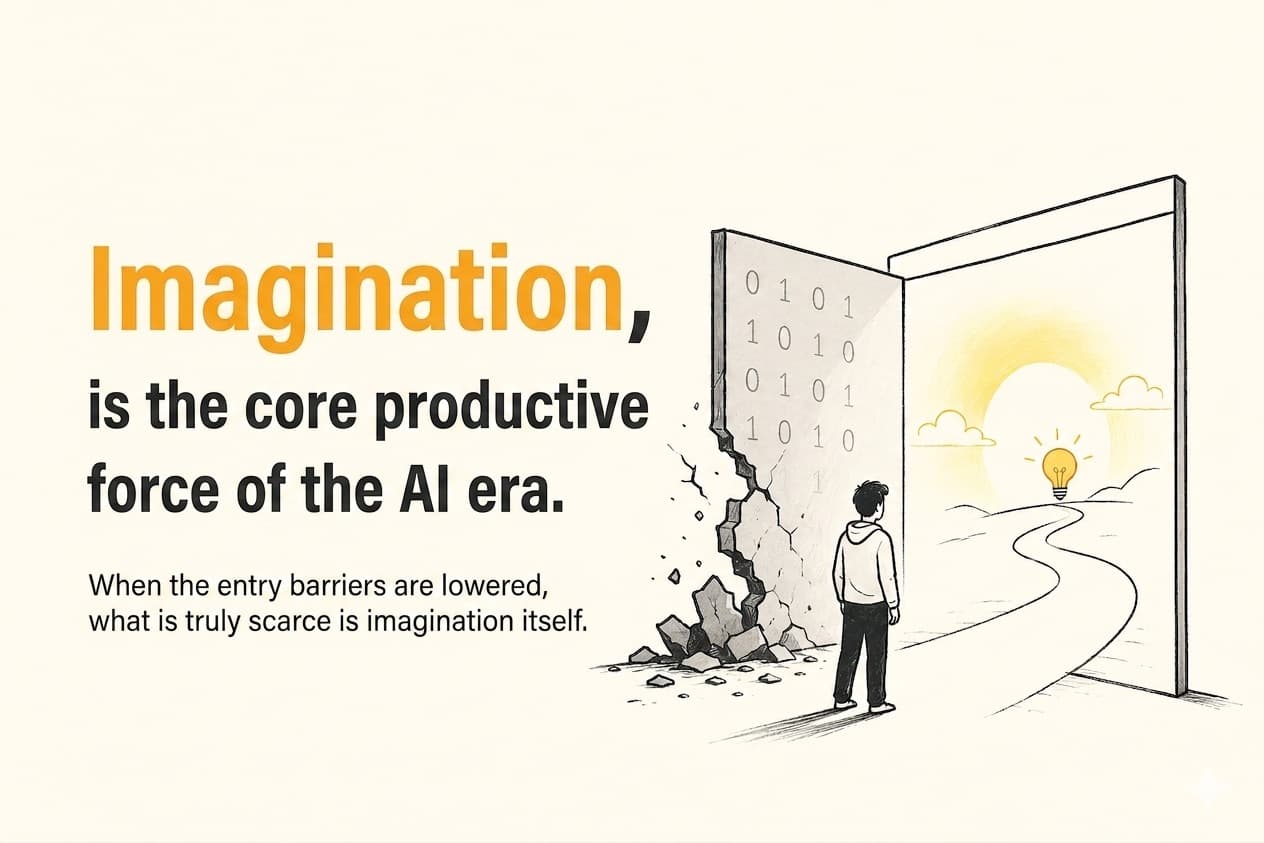
I don't want to use those three points to reassure myself that "programmers are still irreplaceable" and then stop there. On the contrary — I want AI to get stronger, broader, cheaper, more universal — because only after the floor is fully flattened does the truly scarce thing finally surface.
That truly scarce thing is imagination.
V. Imagination, the First Productive Force of the New Era
A while back, Wealthsimple ran an AI Builder hiring program in Toronto. The rules were strange — 3-minute demo. No resume.
1,152 people applied. Every one of them submitted something they'd built.
I was one of those 1,152.
That was the moment I realized something: in the AI era, "what you can build" is becoming more important than "who you are." No resume, no degree filter, no "five-years-of-experience" gate — just your 3 minutes, and your product.
And once the cost of shipping a product drops to one person, one evening, one prompt, one cup of coffee — the real dividing line is no longer technical ability. It's imagination.
Lately I've been screenshotting little products and tools online that I can't stop thinking about:
- A pixel-art café workspace where a tiny cat curls in the corner while your agent is running — like a Slack presence indicator, but much gentler;
- A "Slacking off…" Touch Bar — utterly useless, but it made me laugh out loud;
- The Claude Code pet incubation system the community built — turning an engineer community into a Tamagotchi;
- A Dynamic Island Claude Code octopus — its tentacles are the agents you're running, and the length and color of each tentacle reflect that agent's status and mood.
None of these are "useful."
But they're beautiful, fun, warm. They're the small handcrafted artifacts of this era.
Beauty comes from creation. Creation comes from productive capacity.
When I was a kid I heard that overused line — "life doesn't lack beauty; what it lacks are eyes that can see it."
Today, I'd rewrite it as:
Life doesn't lack software. What it lacks is the imagination behind good software.
And I have to add, as someone with minimalist taste — stacking 100 features into one app has never been my idea of "useful" (yeah, I'm looking at you, Baidu Maps). Truly good software is software that restrains itself, that's designed with intent, that has soul. And soul is the one thing AI can't give. It only comes from someone with taste, judgment, and imagination.
VI. A Good Hunch in a Bad Era
I know writing this now feels a little tone-deaf —
We're in an economic downturn. The fear of AI replacing jobs gets amplified, again and again, by mainstream media. More people are unemployed. The whole conversation is AI this, AI that. The collective mood is anxious, defensive, contracting.
But even so — I have a very strong good hunch about the next few years.
Genuinely disruptive products will arrive, soon.
And as the historical pattern of every major shift tells us, disruption never comes top-down as optimization. It always comes bottom-up as demolition-and-rebuild.
My own bets are:
- A true universal programming language — letting humans program with natural language, flowcharts, voice, and gestures all at once, with AI as the compiler instead of LLVM;
- A product that redefines the phone / computer / iPad — discarding the 1990s notion of "app" entirely, replacing it with units of agent-to-agent collaboration;
- A wholly new interaction modality — maybe not clicking, not typing, not swiping, but something closer to "I think it, and it happens."
I won't be right on all three. But at least one or two will arrive in a form I can't currently imagine.
The economy will recover. The anxiety will pass. AI will get more universal. But this wave of imagination-driven product revolution has already begun.
VII. Closing
So —
If you're a CS-background engineer who got a little shaken by the vibe-coding high schooler: don't panic. The floor dropped by half, but the ceiling got pushed higher. Your job shifts from "knowing how to write" to "knowing how to judge, how to translate, how to catch up."
If you're someone who doesn't write code but has a head full of ideas: this is the best time to be you. 3 minutes, one demo, a single piece of imagination — these used to count for nothing in any official system. Now they're the ticket in.
If you're stuck in the anxiety of this downturn: please embrace the greatest invention of the 21st century. Please embrace the cycles and patterns of history. Please embrace imagination and creativity themselves.
The new era won't reward those who run fastest, nor those who write the most code.
It will reward those who see the furthest, dream the furthest, and then actually go and build it.